
Over my 20 years in the human services and mental health field, I have had the privilege of working with highly sensitive, intelligent individuals from all walks of life—from professionals in demanding fields like tech and law to university students navigating new challenges.
A common thread I see is the search for effective tools to manage intense emotions. Time and again, I have seen Dialectical Behavior Therapy (DBT) provide a clear, transformative path for people navigating everything from anxiety disorders and post-traumatic stress disorder to harmful behaviors.
My mission is to provide compassionate, evidence-based therapy that helps individuals build emotional resilience and create a life worth living. DBT skills training is a cornerstone of this work because it empowers you with practical strategies to find balance, cultivate self-compassion, and move forward at your own pace. It provides a roadmap to not just cope, but to thrive.
What Is Dialectical Behavior Therapy?
Developed by Dr. Marsha Linehan, dialectical behavior therapy (DBT) was originally created to treat borderline personality disorder and address suicidal behavior. Dialectical behaviour therapy is now recognized worldwide as an evidence-based psychotherapy, supported by extensive research and clinical training, for its effectiveness in treating severe mental health issues.
Its success has led to its adoption as an evidence-based treatment for a wide range of mental health conditions. The term “dialectical” refers to the integration of opposites—specifically, the core concepts of acceptance and change. DBT teaches that we can accept ourselves, our experiences, and our emotions in the present moment while also working to build a better future.
Ready to Start Therapy?
Your healing journey can begin today. Fill out the form below to connect with a therapist who truly listens and understands.
DBT is considered the gold standard for treating BPD (Borderline Personality Disorder), with strong evidence supporting its clinical effectiveness in reducing symptoms and improving emotional regulation.
In my practice, I integrate DBT therapy into individual therapy sessions. The framework is built upon four core modules, each offering a distinct set of skills:
- Mindfulness: Learning to be present and aware without judgment.
- Distress Tolerance: Developing skills to navigate crises without making them worse.
- Emotion Regulation: Understanding and managing your emotional responses.
- Interpersonal Effectiveness: Building healthier relationships and advocating for your needs.
A key aspect of DBT is its skills focus—these modules are taught through structured lessons and exercises designed to address skill deficits and help clients improve their emotional and behavioral responses.
This balanced approach makes dialectical behavior therapy DBT a powerful tool for creating lasting, positive change.
Why DBT Skills Training Helps You Manage Emotions More Effectively
When you experience intense emotions, your brain’s decision-making centers can become temporarily hijacked. This can impact your relationships, your work, and your overall daily functioning. DBT skills training is designed to counteract this by strengthening the neural pathways responsible for emotional regulation and effective problem-solving. It is a form of behavioral tech that gives you concrete actions to take when you feel overwhelmed.
This approach is especially helpful for those struggling with trauma, anxiety disorders, substance abuse, or self-harm. Instead of being carried away by powerful emotional reactions, you learn to manage stress, reduce the frequency of negative emotions, and intentionally cultivate positive emotions. It’s about building a new relationship with your inner world.
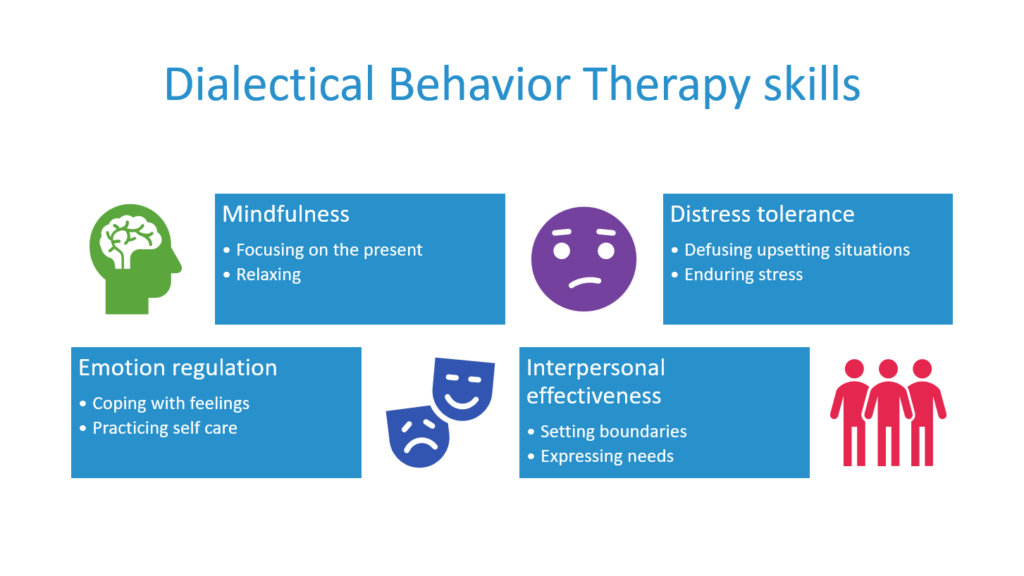
“DBT Skills 1 Wide” by MissLunaRose12 is licensed under CC BY-SA 4.0
Core DBT Skills for Emotional Resilience
Mindfulness Skills: Returning to the Present Moment
Mindfulness is the foundation of DBT. It teaches you to anchor yourself in the here and now. Instead of getting lost in past regrets or future worries, you learn to observe your thoughts and feelings without judgment.
I guide my clients in practicing mindfulness techniques that allow them to notice difficult emotions without becoming consumed by them. This practice of one-mindfully living fosters a sense of calm and control.
Distress Tolerance Skills: Accepting Reality Without Making Things Worse
When you’re in the middle of an emotional storm, it’s easy to react in ways that escalate the situation. Distress tolerance skills are designed for these crisis moments. The core principle is radical acceptance—acknowledging reality for what it is, without fighting it.
From there, you can use crisis survival strategies and self-soothing techniques to get through the moment without resorting to harmful behaviors. These distress tolerance skills are your emotional first-aid kit.
Emotion Regulation: Learning to Manage Emotions More Effectively
This module helps you become the master of your emotional world. Emotion regulation begins with naming and understanding what you are feeling. From there, we work on reducing your vulnerability to negative emotions by building healthy habits and increasing positive experiences in your daily life. Over time, these practices strengthen your overall emotional well-being and give you a greater sense of stability.
Interpersonal Effectiveness: Strengthening Relationships and Self-Respect
Strong relationships are key to a fulfilling life, but they can be challenging to maintain when emotions run high. In Dialectical Behavior Therapy (DBT), developing strong interpersonal skills is essential for managing relationships, improving communication, and regulating emotions.
Interpersonal effectiveness skills teach you how to balance your needs with the needs of others. Using powerful acronyms like DEAR MAN, GIVE, and FAST, you learn to set boundaries, communicate effectively, and maintain your self-respect. I help clients apply these skills in real-world scenarios at work, school, and in their personal lives.
12 DBT Skills That Can Change Your Life
Here is a structured list of 12 fundamental DBT skills that can help you build resilience and create a more balanced life:
Wise Mind
Blending your emotional mind and your reasonable mind to make decisions from a place of inner wisdom.
Observe
Noticing your thoughts, feelings, and sensations without getting stuck on them.
Describe
Putting words to what you observe without adding judgmental labels.
Participate
Throwing yourself completely into the current moment’s activity, fully present and engaged.
Radical Acceptance
Accepting life on life’s terms, without bitterness or judgment, to free yourself from suffering.
TIP
Quickly changing your body chemistry to reduce extreme emotion with:
- Temperature (cold water)
- Intense exercise
- and Paced breathing
STOP Skill
When emotions are high:
- Stop
- Take a step back
- Observe the situation
- and Proceed mindfully
Pros and Cons
Evaluating the advantages and disadvantages of both tolerating a painful situation and acting on impulsive urges.
Opposite Action
Acting opposite to your emotional urge when the emotion is unjustified or unhelpful (e.g., approaching something you fear).
PLEASE Skills
Taking care of your physical health to build emotional resilience:
- treating PhysicaL illness
- balancing Eating
- Avoiding mood-altering substances
- balancing Sleep
- and getting Exercise
Build Positive Experiences
Intentionally scheduling pleasant activities into your daily life to increase positive emotions.
DEAR MAN
An acronym for effective communication:
- Describe the situation
- Express your feelings
- Assert your needs
- Reinforce the positive outcomes
- stay Mindful
- Appear confident
- and be willing to Negotiate
Overcoming Challenges When Practicing DBT Skills
Learning and practicing dialectical behavior therapy (DBT) skills is a journey—one that can be both empowering and, at times, challenging. Many people find that building emotional resilience through DBT requires patience, self-compassion, and a willingness to try new approaches, especially when old habits are deeply ingrained.
One of the first hurdles is developing mindfulness skills. Staying present in the moment, especially during times of stress or anxiety, can feel unfamiliar or even uncomfortable at first. If you find your mind wandering or judging your experience, remember that this is a normal part of the process. Start small: incorporate simple mindfulness techniques like deep breathing, guided meditation, or gentle yoga into your daily routine. Over time, these practices can help reduce symptoms of anxiety disorders and foster greater self-compassion.
Applying distress tolerance skills in real-life situations is another common challenge. When faced with overwhelming emotions, the urge to escape or engage in harmful behaviors can be strong. Practicing radical acceptance—acknowledging reality as it is, without resistance—can be a powerful way to navigate these moments. Using distress tolerance skills such as self-soothing, distraction, or grounding exercises can help you manage difficult emotions and reduce the risk of self-harm or suicidal behavior.
Emotion regulation skills are essential for anyone looking to manage intense emotions more effectively. It’s not always easy to choose a healthy response when negative emotions arise. One helpful strategy is opposite action: if your emotions urge you to withdraw or avoid, try gently moving toward the situation instead. This approach can gradually build your emotional resilience and help you experience a greater sense of control over your emotional reactions.
Interpersonal effectiveness skills are also a cornerstone of DBT, especially for those who struggle with relationships or self-respect. Communicating your needs clearly and assertively can feel daunting, but skills like DEAR MAN provide a structured way to express yourself while maintaining healthy boundaries. Practicing these interpersonal effectiveness skills can lead to stronger, more fulfilling connections with others and a deeper sense of self-respect.
It’s important to remember that progress in DBT happens at your own pace. Working with a DBT therapist can provide the guidance, encouragement, and accountability needed to overcome obstacles and stay motivated. Many individuals also benefit from group therapy, where they can practice new skills in a supportive environment and learn from others facing similar challenges.
DBT is recognized as an effective treatment for a wide range of mental health conditions, including borderline personality disorder, eating disorders, and post-traumatic stress disorder. By equipping you with practical tools to manage emotions and behaviors, DBT can help you move toward a more fulfilling life, even in the face of difficult emotions.
As the field of dialectical behavior therapy continues to evolve, DBT experts are developing new skills and refining existing techniques to address many aspects of mental health. Staying informed about future directions in DBT ensures you’re making the most of your skills training and achieving the best possible results.
How a DBT Therapist Guides You Through These Skills
As a DBT therapist, my role is to guide you through this process with compassion and expertise. DBT sessions typically involve weekly individual therapy sessions, each lasting about 50 minutes, conducted in a clinical or psychiatric setting to provide structured support and skill-building. In our therapy sessions, we explore how these skills apply to your unique challenges. I tailor my DBT work to each individual, providing support for clients who face self-harm urges, intense emotional reactivity, or long-standing patterns of distress.
We work together to track progress, celebrate small victories, and strengthen your mental well-being for the long term. While I primarily focus on individual therapy, I may also recommend group therapy to practice skills in a supportive environment.
DBT in Daily Life: Applying Skills Beyond the Therapy Room
The true power of dialectical behavior is seeing how it transforms your daily life. These skills are not just theoretical; they are practical tools for real-world situations. A professional in the arts might use distress tolerance skills to manage performance anxiety. A student can use interpersonal effectiveness skills to navigate a conflict with a roommate. A parent might use mindfulness to stay grounded during a stressful family conversation.
I have seen clients use these skills to build a greater sense of emotional balance and create a fulfilling life rooted in clarity and purpose. They learn to stop reacting and start responding, which fundamentally changes their experience of the world.
Current Status, Research, and Future Directions in Dialectical Behavior Therapy
The field of dialectical behavior therapy continues to evolve. Research published in journals like the Journal of Personality Disorders (J Personal Disord) consistently validates its effectiveness. Recent developments have expanded its use for treating many aspects of mental health, including trauma, anxiety, and other forms of emotional dysregulation. The future directions of DBT point toward even more refined and accessible applications, ensuring it remains a vital evidence-based treatment.

Photo by Vitaly Gariev on Pexels
How to Know If DBT Therapy Is Right for You
If you find yourself struggling with intense emotions, unstable relationships, or difficulty managing stress, you may benefit from DBT skills training. Do you feel like your emotions control you? Do you act impulsively in ways you later regret? Do you long for a greater sense of inner peace and control?
Answering yes to these questions is a sign that DBT could offer the support and structure you need. Making progress happens at your own pace, and the journey itself builds confidence and self-awareness.
Begin Dialectical Behavior Therapy (DBT) Work Today to Build a Life Worth Living
I want to close by inviting you to take the next step toward emotional resilience. There is profound power in accepting reality while simultaneously learning the skills to change your life for the better. My vision is to help you manage emotions effectively and move forward with clarity and confidence.
Whether you are in Connecticut, New York, Florida, or one of the over 40 other states I serve through telehealth, personalized DBT therapy can help you thrive. You have the capacity to transform your past struggles into wisdom and strength. It all starts with the decision to begin.