

Why Communication Skills Matter in Daily Life
We all face moments where we need to ask for something, say “no” to a request, or resolve a conflict. For many highly sensitive, intelligent individuals, these moments can feel paralyzing. You might worry about upsetting someone, fear rejection, or struggle with old habits of people pleasing. Perhaps you avoid the conversation entirely, hoping the issue will just disappear.
But silence rarely solves the problem. Instead, avoiding difficult conversations often leads to resentment, burnout, or a sense that your needs don’t matter.
This is where communication skills become vital for your mental health. Clear, direct communication isn’t just about getting what you want; it is about honoring your own voice and maintaining self respect.
One of the most effective tools available is Dialectical Behavior Therapy (DBT). Specifically, a set of skills designed to help navigate interpersonal effectiveness—with DEAR MAN DBT being the most well-known.
My mission is to help you move through life with confidence and clarity. When you learn to express your needs effectively, you build resilience. You create relationships based on mutual respect rather than fear or avoidance. Let’s explore how you can use these tools to transform how you connect with others.
Ready to Start Therapy?
Your healing journey can begin today. Fill out the form below to connect with a therapist who truly listens and understands.
What Is DEAR MAN DBT? A Core Tool in Dialectical Behavior Therapy
DEAR MAN is an acronym used in Dialectical Behavior Therapy to help people get their needs met in a way that preserves relationships and self-respect. It falls under the “Interpersonal Effectiveness” module of DBT skills.
Think of it as a roadmap for social interactions. It guides you on what to say and how to say it when the stakes feel high. Whether you are negotiating a raise, setting a boundary with a family member, or asking a partner for more support, DEAR MAN provides the structure you need.
These DBT skills support self advocacy by removing the guesswork. Instead of reacting emotionally or shutting down, you have a clear plan. You know exactly how to express your feelings and assert your needs without being aggressive.
Clients often use these skills to transform their lives. They go from feeling unheard and frustrated to feeling empowered and understood. DEAR MAN works because it balances the objective facts of a situation with your personal feelings, all while keeping the relationship in mind.
Why Practicing DEAR MAN Works: The Science and the Skill
Practicing DEAR MAN is effective because it keeps you grounded. When we feel anxious about a conversation, our brains often go into “fight or flight” mode. We might become defensive, or we might crumble and give in just to end the tension.
DEAR MAN helps you stay focused on your goal. It encourages you to act like a broken record—calmly repeating your point without getting derailed by arguments or distractions. This persistence is key. It shows the other person that you are serious and that your request is important.
Furthermore, the skill emphasizes non-verbal cues. Maintaining eye contact and keeping a steady voice signals confidence, even if you are shaking on the inside. It prevents you from becoming loud or aggressive, which usually shuts down communication. Conversely, it stops you from mumbling or looking away, which can make you seem unsure.
By reducing confusion and fear, DEAR MAN allows you to communicate with direct clarity. It is a powerful antidote to people pleasing. Instead of prioritizing everyone else’s comfort over your own well-being, you learn to treat your needs as valid and worthy of attention.
Understanding Each DEAR MAN Skill Step-by-Step
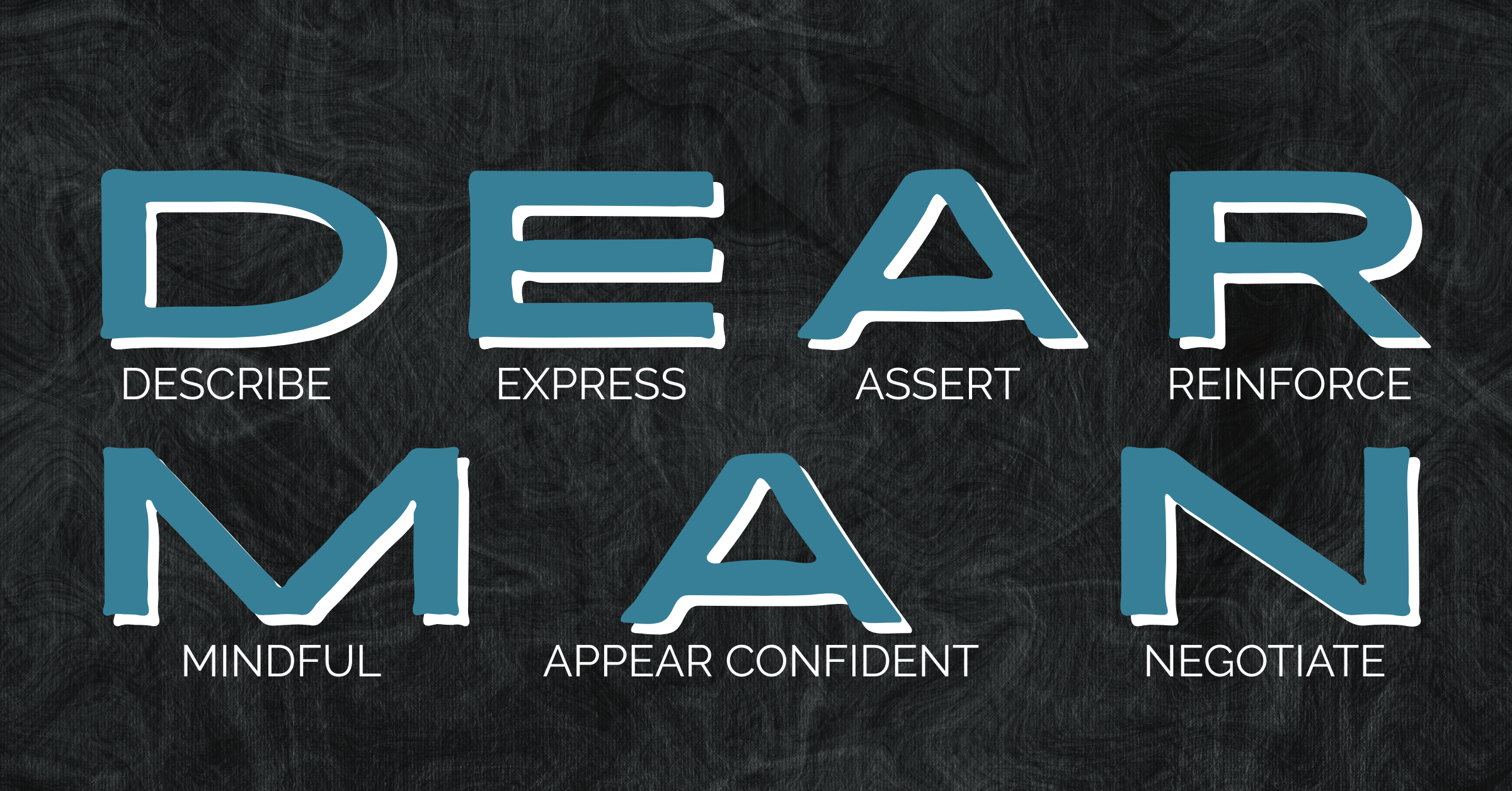
Let’s break down the acronym so you can see exactly how DBT’s DEAR MAN skills work in practice. The first part, DEAR, covers what you say. The second part, MAN, covers how you say it.
1. Describe
Start by describing the current situation. Stick strictly to the facts. Avoid judgmental language or interpretations.
- Incorrect: “You’re always ignoring me and being rude.”
- Correct: “I noticed that when I started speaking about my day yesterday, you picked up your phone and started scrolling.”
By sticking to facts, you reduce the chance that the other person will get defensive.
2. Express
Next, express your emotions regarding the situation. Use “I” statements. Don’t assume the other person knows how you feel.
- Example: “I feel unheard and unimportant when I am sharing something with you and I don’t get a response.”
3. Assert
Assert yourself by asking for what you want or saying no clearly. Do not expect others to read your mind.
- Example: “I would like to request that we put our phones away for 20 minutes when we get home so we can really catch up.”
This is where self respect comes in. You are stating that your needs are valid.
4. Reinforce
Reinforce the person ahead of time by explaining the positive effects of getting what you want or the negative effects of not getting it.
- Example: “If we do this, I’ll feel much more connected to you and less irritable in the evenings.”
This helps the other person see the value in your request. Appreciation goes a long way.
5. Mindful
Stay mindful of your goal. Do not get distracted.
- Broken Record: Keep your point front and center. If they argue, simply restate your request calmly. “I understand you’re tired, but I would still like us to have 20 minutes of phone-free time.”
- Ignore Attacks: If the other person attacks you or tries to change the subject, ignore the distraction and return to your point. Do not take the bait.
6. Appear Confident
Appear confident with your body language and tone. Stand straight, make eye contact, and speak clearly.
- Even if you are terrified, acting confident changes how the message is received. It commands respect.
7. Negotiate
Be willing to negotiate. If you can’t get exactly what you want, be ready to offer a reasonable alternative.
- Example: “If 20 minutes is too long right when you get home, could we try 10 minutes? Or maybe we can do it after dinner?”
This shows you are flexible but still firm on the core need.

Photo by Falaq Lazuardi on Unsplash
DEAR MAN in Daily Life: Real Time Examples You Can Try
Seeing these steps is helpful, but applying them in daily life takes practice. Let’s look at how you might use this in real time.
Scenario 1: Workplace Overload
Your boss keeps adding tasks to your plate, and you are drowning. You need to set boundaries.
- Describe: “Over the past week, I have received three new major projects on top of my current workload.”
- Express: “I am feeling overwhelmed and am concerned that the quality of my work will suffer if I am spread too thin.”
- Assert: “I would like to pause accepting new assignments until I complete the Anderson report next Tuesday.”
- Reinforce: “This will ensure the Anderson report is accurate and delivered on time, which I know is a priority for the team.”
- Mindful: (Boss says, “But everyone is busy.”) “I hear that the team is busy, and I still need to pause new assignments to maintain quality on the current report.”
- Appear Confident: Speak with a steady voice; don’t apologize for being human.
- Negotiate: “If pausing all assignments isn’t possible, can we prioritize which of the three new projects can wait until next week?”
Scenario 2: Relationship Dynamics
You feel like you are always the one planning dates with your partner.
- Describe: “I’ve planned our last four weekend outings.”
- Express: “I feel exhausted and a bit lonely in this effort, as if I’m the only one invested in our quality time.”
- Assert: “I would like you to plan our date for next Saturday.”
- Reinforce: “It would make me feel so cared for and excited to see what you come up with.
I encourage you to write out your own script before a difficult conversation. Having your points written down helps you figure out exactly what you want to say so you don’t get flustered in the moment.
How DEAR MAN Supports Mental Health and Self-Respect
Using DBT’s DEAR MAN skills does more than just solve immediate problems. It fundamentally shifts how you view yourself. When you communicate directly, you stop carrying the heavy burden of unexpressed resentment.
Direct communication reduces emotional overload. It clears the air. You no longer have to waste energy ruminating on what you should have said.
Furthermore, sticking to boundaries helps you feel grounded. Every time you use DEAR MAN to protect your time or energy, you are sending a message to yourself: “I matter.” This builds profound self respect.
Over time, this leads to improved relationships. People actually prefer clarity. They want to know where they stand. By stopping people pleasing behaviors, you invite others to know the real you, not just the version of you that says “yes” to everything. This authenticity fosters deeper connection and stronger resilience against stress.
When DEAR MAN Feels Hard: Common Obstacles and How to Get Unstuck
Even with a script, using DEAR MAN can be scary. You might notice fear arising—fear of conflict, fear of rejection, or fear of being seen as “difficult.”
Common obstacles include:
- Emotional Overload: You might get so angry or sad that you forget your lines.
- Old Patterns: The urge to apologize or back down might feel overwhelming.
- Reaction from Others: The other person might get angry, confused, or try to guilt-trip you.
If you get stuck, remember to breathe. It is okay to take a pause. Remind yourself of your goal. If the other person starts putting words in your mouth or attacking you, use the “Broken Record” technique. Simply return to your “Assert” statement.
“I hear you are upset, and I still need us to discuss the budget.”
Stay calm. You cannot control how they react, but you can control how you deliver your message. If you struggle with this, know that it is a skill like any other. It takes repetition to master.
DEAR MAN at Groundbreaker Therapy: How I Help Clients Build These Skills
At Groundbreaker Therapy, clients receive support in building DEAR MAN skills through a highly personalized and practical approach. The focus is on real-world application—sessions are designed to help clients actively practice effective communication strategies tailored to their unique personalities and situations. Whether working virtually or in person, the process involves role-playing challenging conversations, exploring potential obstacles, and refining techniques for clarity and confidence. This experiential method ensures that each client not only understands the DEAR MAN framework but is equipped to use it confidently in everyday interactions, fostering more effective communication and meaningful connections.
DEAR MAN can be tailored to fit your specific personality and situation. It’s not just about reading through the skills, but actively practicing them—such as role-playing conversations you may be dreading with a boss or parent. This approach helps you see what works, what doesn’t, and how to refine your communication effectively.
Evidence-based resources, such as those from Guilford Press, can deepen understanding of these protocols. The key is putting these concepts into action and identifying specific barriers—why is this request so hard to make? What belief is holding you back?
Together, we dismantle the fear and build a strategy that feels authentic to you.

Photo by Vitaly Gariev on Unsplash
Communication Is a Learnable Skill and a Pathway to Change
If there is one thing I want you to take away, it is this: Effective communication is not a personality trait you are born with. It is a learnable skill.
You can learn to ask for what you need. You can learn to set limits without guilt. You can learn to navigate conflict with grace.
Reflect for a moment. Where do you struggle most? Is it at work? With your spouse? With your parents? Pick one small area to try DEAR MAN this week. Write out your script. Practice it in the mirror.
If you find yourself needing more support, remember that you don’t have to do this alone. Therapy can provide the safe space you need to build these muscles. By investing in these skills, you are investing in your own freedom, creating a life defined not by what you feel you must do, but by who you truly are.
Dr. Matthew G. Mandelbaum offers compassionate, evidence-based therapy to help you navigate life’s challenges. If you are ready to build resilience and master skills like DEAR MAN, reach out to schedule a consultation.